

Pride Is Not Just Celebration. Pride Is Camp.
When some people hear the word camp, they think of summer camp. But no, think sequins. Think four-inch eyelashes. Think a Marie Antoinette wig made of neon zip ties. Think something so theatrical, so garish, so deliciously excessive that you’re rolling on the floor. We’re talking about Queer Camp Culture.
Camp is often understood as a style or sensibility rooted in exaggeration, theatricality, artifice, irony, glamour, flamboyance, and pleasure. Susan Sontag famously described it as “a mode of enjoyment, of appreciation, not judgment.” Camp is not just a look. It is a way of reading the world, performing the self, and finding meaning through style, wit, exaggeration, and self-aware display.
It’s easy to see colour, celebration, and spectacle during Pride month, but it’s not as easy to understand where that expression comes from and the pressure underneath it.
Pride grew out of lives shaped by stigma, rejection, coded language, and the constant demand to be smaller. For a very long time, and still today, Queer people have been told in all kinds of ways to shrink themselves. That pressure has shown up through homophobia, transphobia, family rejection, workplace silence, religious judgment, and laws that tried to control who people could love and how they could live.
When people live under that kind of pressure, the energy does not disappear. It shows up in style, gesture, humour, performance, coded references, chosen family, and defiant joy.
The complaint that Queer people are being “too loud” leaves out the history underneath that loudness. Camp developed in conditions where people needed ways to find one another and create space for themselves within a culture that kept narrowing the frame. A coded phrase like Polari could carry recognition. A gesture, a tilt of a hat, a knowing reference, even being “a friend of Dorothy,” could do social work in plain sight. What some people see as excess often carries communication, creativity, and community.
Camp carries pressure, survival, and joy at the same time. The joy is shared, hard-won, and rooted in people creating beauty and pleasure in conditions that often denied them both.
That is the heart of the interactive experience, Pride Is… Camp! The session explores four connected ideas: visibility, protection, community, and celebration.
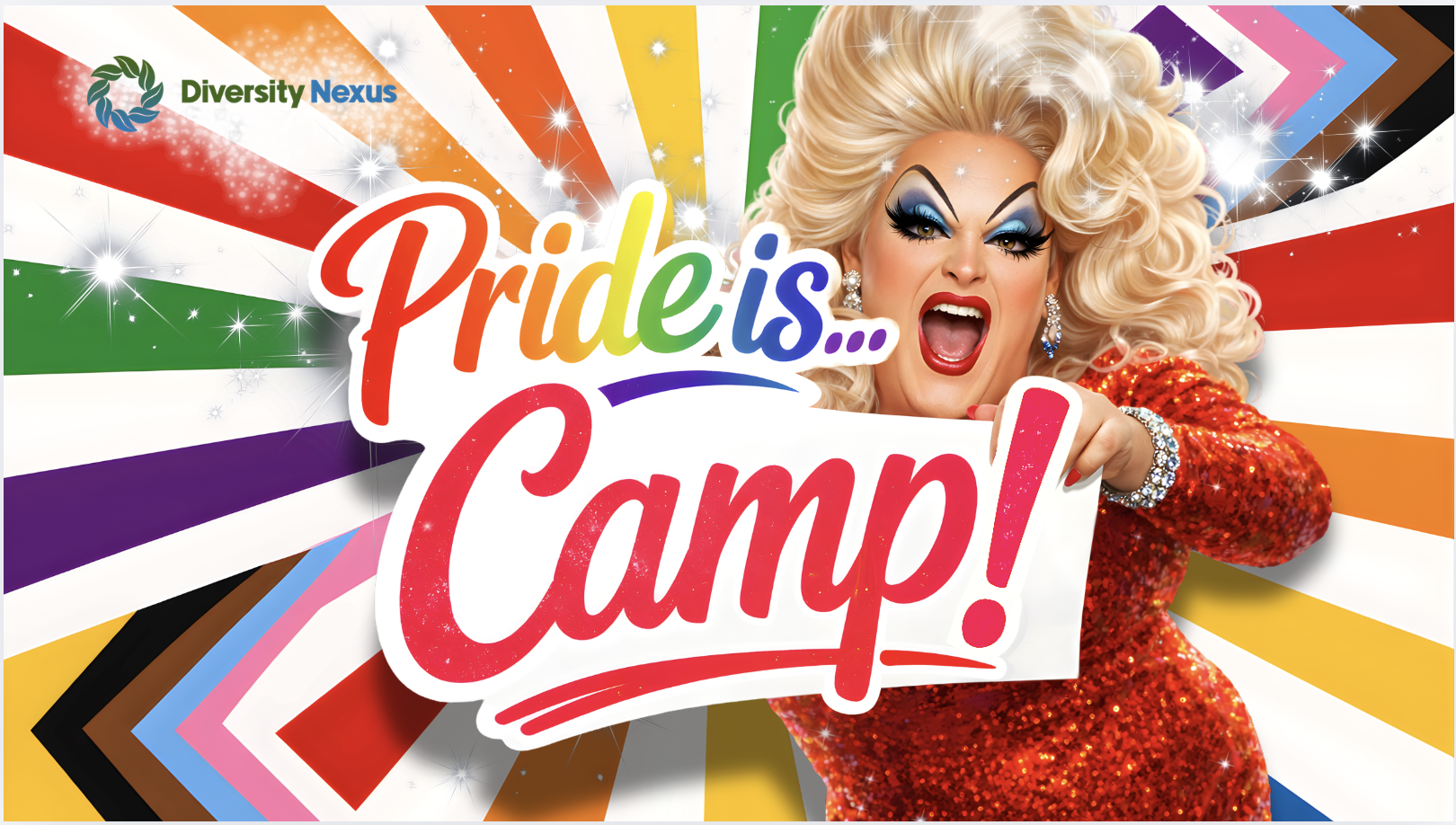
Camp creates visibility. Through style, humour, performance, and exaggeration, Queer identity becomes legible in ways that are cultural as much as personal. Visibility is about recognition and presence. It is about taking up space in ways that can be read and understood.
Camp creates protection. It has helped people recognize one another, test the waters, and signal shared understanding while still navigating risk. In spaces where direct openness was not always safe, coded expression carried meaning. A look, a reference, a style choice, or a shared sense of humour could communicate safety.
Camp creates community. It creates shared language, shared references, and shared delight. It makes room for recognition, support, learning, healing, and the freedom to be more fully expressed with people who understand the context.
Camp creates a space for celebration. It turns pressure into expression and expression into joy. Celebration in Queer culture carries history. It responds to it and reshapes it. The joy reflects people making space for themselves and each other.
This is why Pride Is… Camp! matters for both allies and Queer participants.
For allies, it opens up a fuller understanding of Pride beyond surface-level symbols. It helps people understand the culture, history, and expression behind what they are seeing.
For Queer participants, it offers recognition and language. It names something many people already feel and situates it within a broader cultural context.
Once you start seeing that pattern, you can notice echoes of it in other communities. You can look, for example, at Carnival in the Caribbean and in North America in places like Miami, New York, and Toronto. The histories are different and should stay distinct, but there is a recognizable pattern in the way public celebration can emerge from communities shaped by oppression.
Caribbean Carnival, which began in Trinidad in the wake of emancipation from slavery, erupted into a public expression of colour, music, movement, and freedom that was big, visible, and impossible to ignore – just like Camp.
That is why this conversation matters at work. Too often, Pride programming stays at the surface. It acknowledges identity without helping people understand expression. It celebrates inclusion without helping people think about the cultural forms people use to survive, connect, and be seen.
A stronger Pride conversation helps teams understand why Pride looks the way it looks and why that expression deserves to be read with care.
Pride Is… Camp! was designed for that purpose. It is a 60-minute hosted, gamified, interactive experience that helps teams explore Pride in a thoughtful, engaging, and memorable way. It gives people a shared language for understanding how Camp creates visibility, protection, community, and celebration, and why that matters.
Because once you understand Camp, Pride starts to read differently. It starts to look like history, creativity, joy, defiance, and beauty in full radiant colour.