

Maybe We Do Need to Gatekeep
What if some gatekeeping means asking people to come with care, context, and actual knowledge?
There is a certain kind of video that shows up online all the time now. Someone turns on the camera, talks like they are on FaceTime with a friend, and shares a thought they seem to believe is deeply original. The tone is casual, the confidence is high, and the idea is framed as “just an opinion.” Then you listen closely and realize the opinion is not new or interesting. It is a familiar, harmful idea with a ring light and a softer delivery.
Social media makes everything feel individual and harmless. Someone is “just asking questions,” or “just sharing their perspective.” But a harmful idea does not become harmless because it’s delivered over a get-ready-with-me. A stereotype is still a stereotype, whether or not it is framed as a hot take, and misinformation still travels, even if the person spreading it believes they are being honest.
A while back, there was a meme called Gaslight Gatekeep Girlboss. It sounded ridiculous because it was supposed to, but those words became popular for a reason. Each one gave people a way to name a real pattern.
Gaslighting names a form of manipulation where someone makes another person question their reality, memory, or perception. It gave people language for something confusing and destabilizing. Online, it now gets used for almost any disagreement, misunderstanding, or behaviour someone does not like.
Gatekeeping names the control of access. It can describe who gets information, opportunity, belonging, recognition, or credibility. Online, it now gets used any time someone names a boundary, standard, correction, or qualification.
Girlboss named a version of empowerment built around individual achievement, ambition, and success. It became useful because it also revealed how empowerment language can be used without changing the systems underneath. Online, it now gets used for almost any minor act of confidence, productivity, or self-branding.
The problem is not that language changes. Language always changes. The problem is that these words were useful because they helped people name patterns of power. When they get stretched too far, they stop pointing clearly at the behaviour they were created to name.
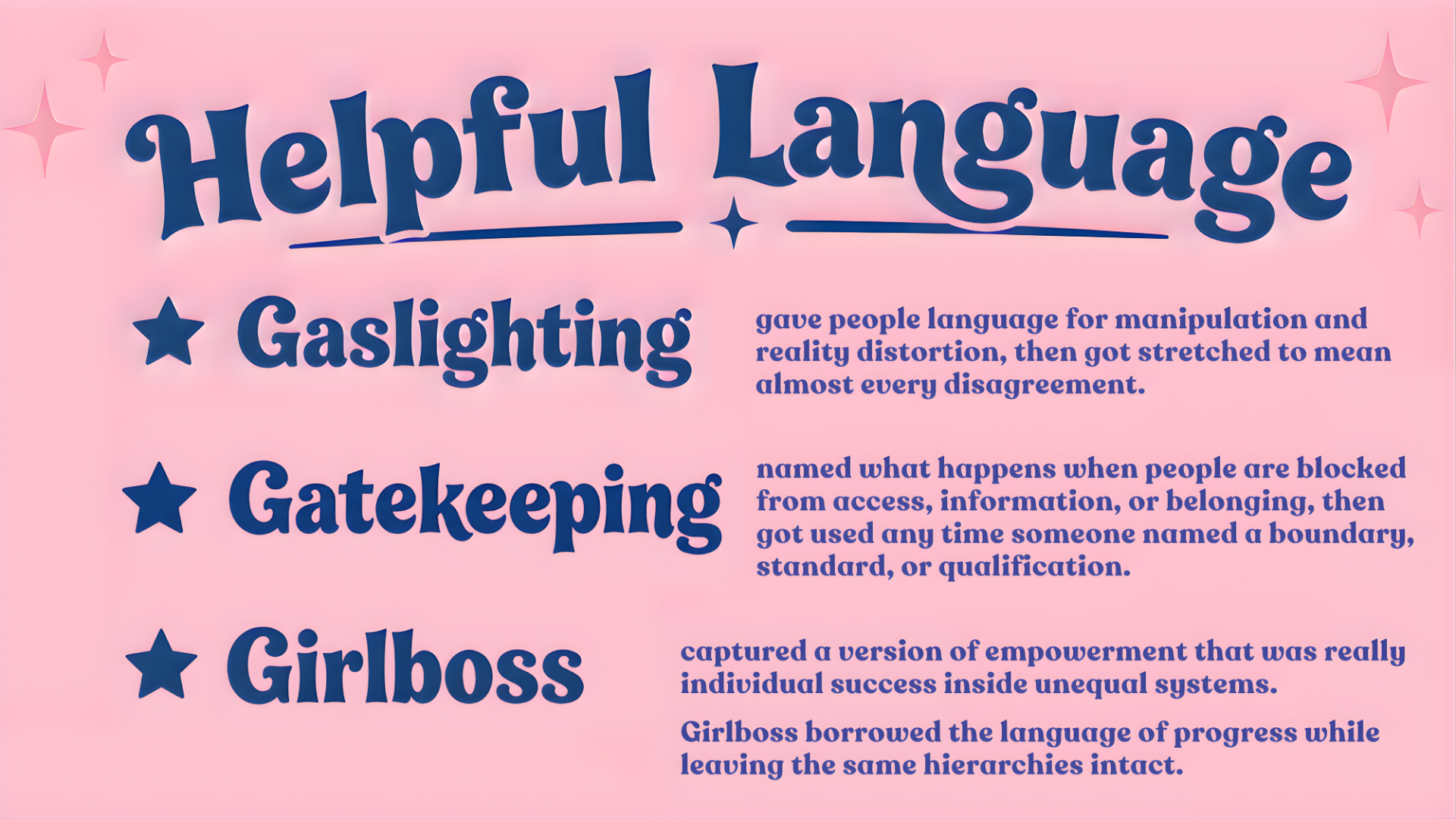
Pink retro-style graphic titled “Helpful Language,” with navy blue text and star accents. The design explains how the terms gaslighting, gatekeeping, and girlboss entered popular language and how their meanings shifted through overuse.
When every boundary gets called gatekeeping, people start treating standards like exclusion. When every critique gets treated like silencing, people can say harmful things and act like they are being punished for being honest.
Then the conversation gets pulled toward their right to speak, while the harm their words repeat gets pushed aside. But this is where a little gatekeeping can be useful. Your For You page is curated by you.That means you can ask better questions before treating someone like an authority on a community, history, or experience they may not have taken the time to understand. A lot of people want to treat public opinion as if it exists outside of responsibility. They want to put a claim into the world, let it gather attention, let it do harm, then step behind “well, that’s just my opinion.” That phrase can become a shield for laziness. It can become a way to avoid learning. It can become a way to say something harmful without carrying the weight of having said it.
What did they read? Who taught them this? Which people from that community have they listened to? What history are they relying on? Who is affected by what they are saying? Those are bare minimum questions.
Everyone is entitled to think, but not everyone is entitled to have every thought treated as expertise and insight. The internet has made confidence look like credibility. Someone can speak smoothly, use the right words, and sound self-assured, yet still repeat ideas that have harmed people for generations.
Workplace Cultural Literacy
The same thing shows up at work in quieter language. Someone talks about “professionalism,” and underneath it is a narrow idea of whose communication style counts. Someone says a candidate is “not quite ready,” and underneath it may be discomfort with how that person shows up. Someone says an employee is “too much,” “too direct,” “not polished enough,” or “hard to read,” and underneath that may be a whole set of assumptions about race, gender, class, disability, accent, culture, and power.
Cultural literacy is the skill of hearing what sits underneath the sentence. A message can be understood by the results it produces over time, because that is how systems work. You do not take a system at face value; you have to look at what the message or system keeps producing. You look at who benefits, who adjusts, who gets questioned, and who keeps absorbing the impact. Better standards would change the conversation.
The Gatekeeping We Need
Before repeating a claim about a community, know where it comes from. Before calling something “just an opinion,” ask who has to absorb the impact of that opinion. Before treating confidence as intelligence, ask whether the person has actually done the work.
That is the kind of gatekeeping more spaces need. The kind that protects knowledge from being flattened into content. The kind that says lived experience, study, context, and care should matter. The kind that refuses to treat ignorance as insight just because it was delivered with confidence.
People can speak about communities they do not belong to. People can learn histories they did not inherit. People can enter conversations that are new to them. They can also be expected to come with care, accuracy, and some basic respect for the people being discussed.
When someone is speaking about a community they do not belong to, a history they have not studied, or a harm they do not carry, “where are your sources?” should not be treated like an attack. It is a reasonable place to begin.